OPEN HISTORICAL RESEARCH

Call for Information

Not everything is written down. Sometimes the answer to a historical question lies in someone’s memory, an old photograph or a document kept in a drawer.

These are some of the questions I am currently investigating. Perhaps you can help.

1945 · Amsterdam / Germany

The Arbeitseinsatz in 1945

My father, Karel van Elmpt, left an account of his journey from Amsterdam to Germany, where he had to work in the last months of the war.

I am comparing his memories with documents and other accounts. I am looking for accounts from people who made the same journey.

Read Karel’s case study →

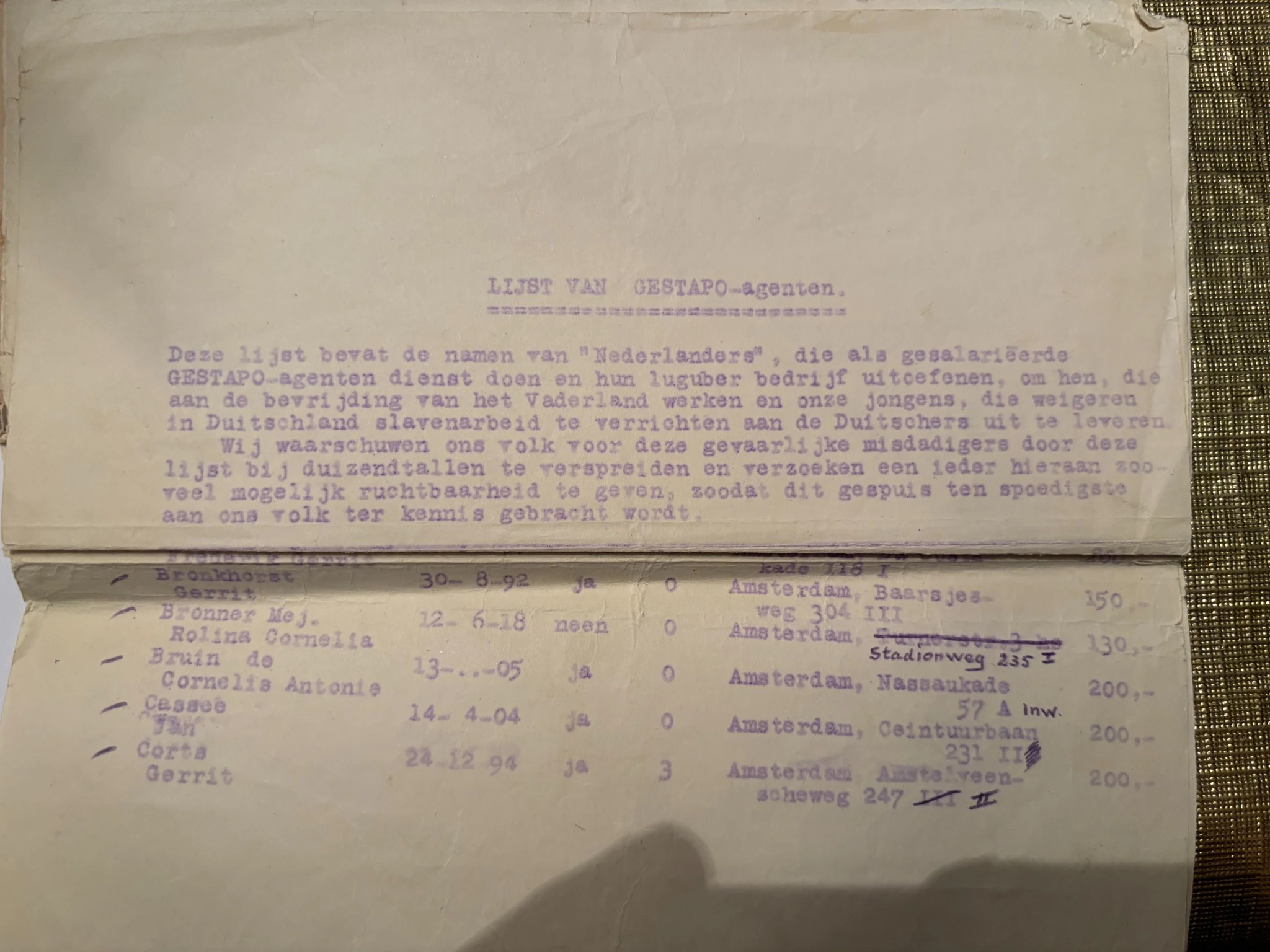
Wartime document headed Lijst van Gestapo-agenten, with names and addresses
A surviving list headed “Lijst van Gestapo-agenten”.

1944 · Alkmaar / Amsterdam

A Gestapo list of names of collaborators

Various accounts of an SS deserter who was brought to Alkmaar/Oudorp, where he died, also mention a list of names.

According to these accounts, an unidentified person handed the organisers of the illegal paper Etappe der Ineenstorting a list containing names and addresses of people described as collaborators, to be copied and distributed among resistance groups.

Read A Body in a Canal →

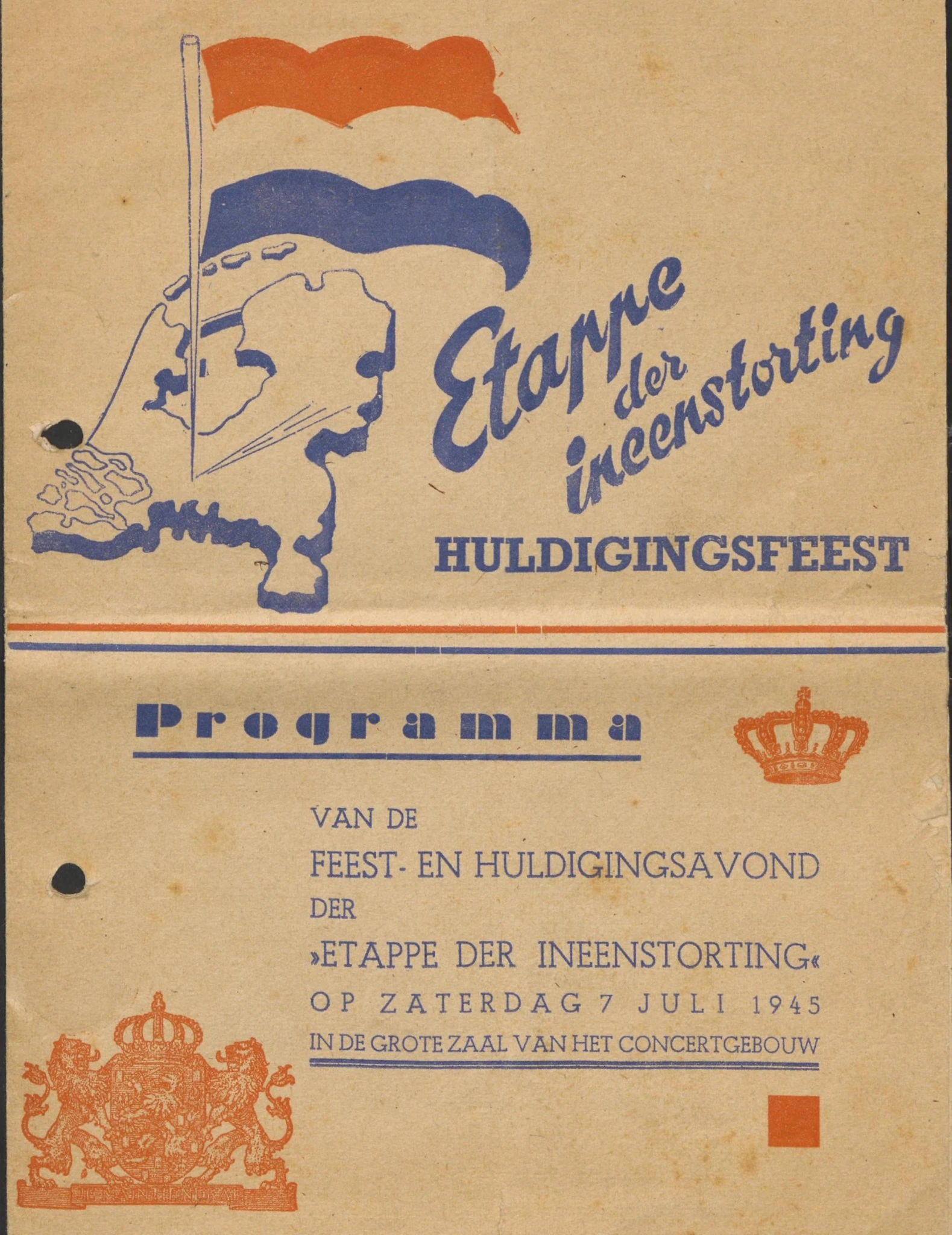
Programme of the Etappe der Ineenstorting celebration on 7 July 1945
Programme for the Etappe der Ineenstorting celebration, 7 July 1945.

Clandestine press · Amsterdam

Etappe der Ineenstorting

I am investigating the clandestine wartime paper Etappe der Ineenstorting and the people who wrote, produced and distributed it.

This paper was widely distributed twice a day with updates from Radio Oranje. The organisation of it all was impressive.

Explore the research projects →

1940–1945 · Amsterdam

Amsterdam’s Municipal Electricity Company During WWII

During the German occupation, the Amsterdam Gemeente-Energiebedrijf (GEB) continued its daily work while some employees also became involved in resistance activities, under the nose of the Germans.

I am looking beyond the better-known accounts to understand the people who worked there and what happened inside and around the company.

Explore the research projects →

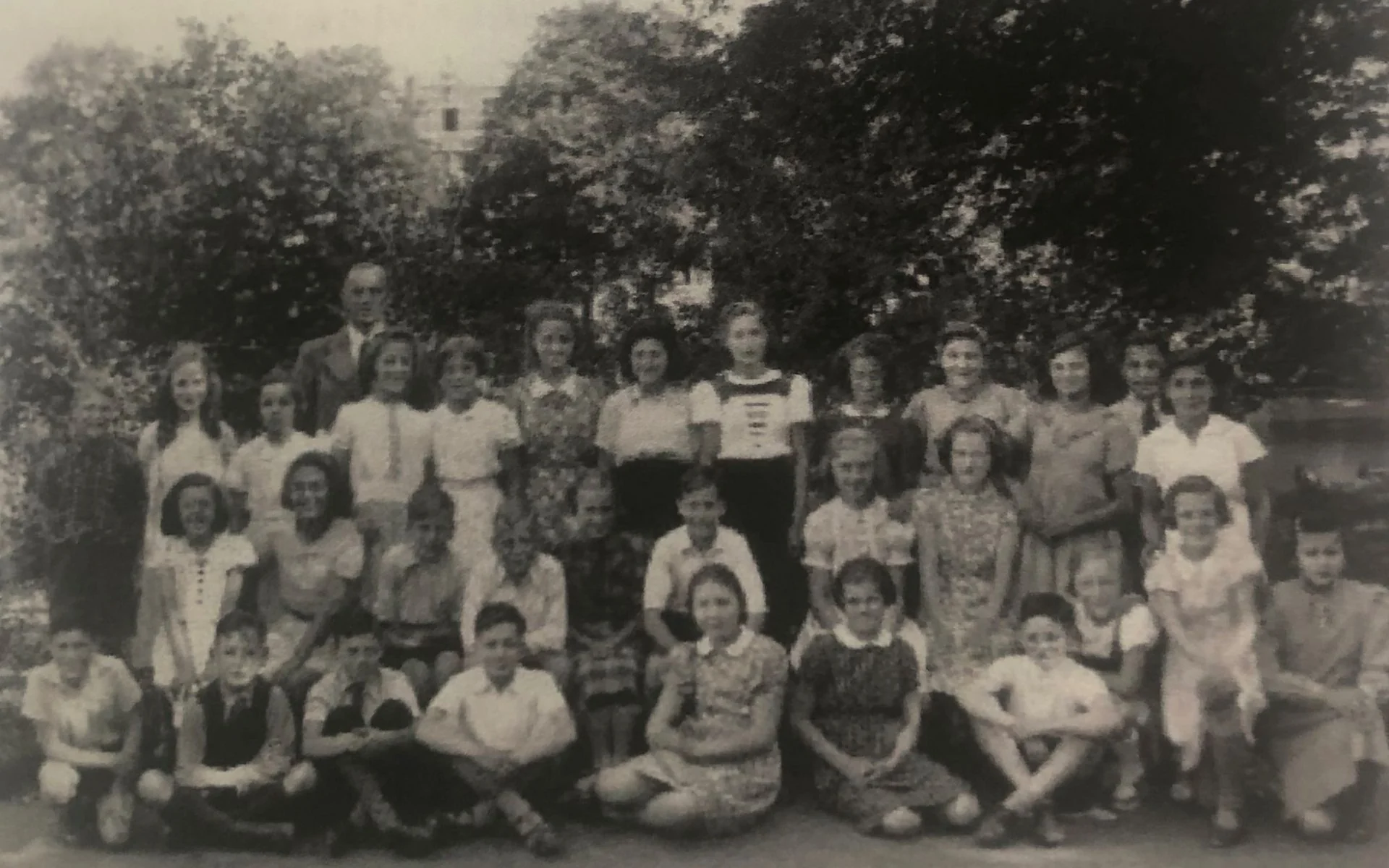
Primary school class photograph, June 1940, Amsterdam
June 1940

A REGULAR FEATURE

Do You Recognize This Photograph?

This is a primary school photograph from June 1940, one month after the German occupation of the Netherlands. Almost all the children in this photograph were Jewish, and I fear that few survived the war.

The school was somewhere in or around De Pijp in Amsterdam. Can anyone help identify which school it was? Does anyone recognise one or more of the children in this photograph? Please get in touch if you have even the smallest clue.

Even a small clue can help

You do not need to know the whole story. A name, date, address, family recollection or document may help me find a missing connection. If you are unsure whether something is relevant, you are welcome to ask.

I read and assess the information myself. Nothing you send is published automatically, and I will discuss any use of personal material with you first.

Use the topic-specific email buttons above, or contact me through the existing website contact page. If you have a photograph or document, tell me what you have and we can arrange how to share a copy.

info@whenthenwasnow.com

The Liese-Aktion

The Demand for Labour

Hermann Liese (1907–1972) was a Reichsamtsleiter within the Nazi Party organisation and an associate of Joseph Goebbels. In early October 1944 he was sent to the Netherlands with a twofold assignment: to remove machinery and raw materials from the Dutch economy and to gather Dutch labourers for the German war effort.

On 15 October, a German meeting chaired by Christiansen was attended by Liese, Seyss-Inquart, Rauter and others. They discussed the possibility of deporting large numbers of men from cities in the western Netherlands. Their calculations assumed that some 5,000 men could be transported each day. This meeting formed part of the preparations for the round-ups and the subsequent labour mobilisation campaign.

Several round-ups took place in October and November 1944, the largest being those in Rotterdam and The Hague, in which more than 70,000 men were seized in total. This method, however, had major disadvantages. It required large numbers of German soldiers, who were in short supply, particularly during the Battle of the Bulge in December. The round-ups provoked widespread public resistance; once the element of surprise had been lost, boys and men went into hiding en masse, making the operations less effective. Loe de Jong also describes how men were rounded up whom the Germans would have been better off leaving in their existing jobs. Even economically, therefore, this brutal method was not always effective. Liese consequently devised another scheme for recruiting labourers.

The Liese-Aktion

Under what became known as the Liese-Aktion, men were ordered to report to employment offices to register for labour deployment. In return for their work, their households or families were allocated extra food ration coupons.

The first notices were posted in Amsterdam on 14 December. On 29 December, a further announcement ordered all men born between 1905 and 1928, inclusive, to register between 5 and 8 January. They would later receive a summons to depart for their assigned workplaces in the Netherlands or Germany.

The Dutch government in exile and the resistance reacted forcefully and decisively. On 2 January the government urged everyone to ignore the German summons, and on 5 January the resistance resorted to violence. Nine pro-German employment-office staff were attacked, six of whom were killed. That evening the Spieghelschool on Marnixstraat (where the present-day DeLaMar Theater stands), which was being used for registration, was set on fire. On 7 January a bomb was also detonated at the Koningin Emmaschool, which had subsequently been used for registrations.

German reprisals were severe. On 6 January five resistance members were executed outside the burnt-out Spieghelschool, and on 18 January a further eleven employees of the Regional Employment Office were shot at Rozenoord. Nevertheless, the Liese-Aktion was not a success. An estimated 4,000 to 5,000 men registered in Amsterdam; Loe de Jong estimates that fewer than 10,000 men were recruited in total across the various cities. Round-ups continued alongside the registration scheme, however, so the overall number of men pressed into labour during January and February 1945 was considerably higher.

The Actual Departures

Those who had registered in Amsterdam were summoned on 17 January to report to the Apollohal between 20 and 22 January with the prescribed luggage. From there they were taken to the Levantkade, where workers from around the country were initially assembled. Under normal circumstances they then travelled by boat across the IJsselmeer to the Van Heutsz barracks in Kampen. Men from other parts of the country were also gathered for onward transport.

The final week of January was so bitterly cold that the waters around Kampen became unnavigable, so trains were used for these transports instead. Loe de Jong describes a train transport that arrived in Kampen from Amsterdam on 27 January 1945 and over the following days, a substantial proportion of its passengers being boys aged around fifteen to eighteen. The arrivals were inadequately dressed and weakened; roughly twenty of the boys were reportedly found to have frostbitten feet.

On 30 January 1945, the physician Willem Johan Kolff reported to Mayor Sandberg on conditions in the barracks. The problems he identified included severe exhaustion; inadequate clothing, footwear and blankets; lice; dysentery; frostbite; and illnesses including diphtheria, tuberculosis and influenza.

For those sent on to Germany, the next destination was Lehrte, a small town near Hanover. It had a Durchgangslager (transit camp), where conscripted labourers were taken before being transported to their final destinations. A large proportion of the Dutch men who passed through Lehrte were put to work on the railways.

For the German occupiers, the Liese-Aktion ultimately ended in failure. For the thousands of men who were nevertheless taken away, however, it marked the beginning of what was often a terrible period of forced labour, deprivation and uncertainty.